This time, we have a short announcement regarding expanded English support for the programming language VCSSL.
Since May 2023, RINEARN has been working on a project to significantly expand the English documentation for our software and for VCSSL by producing high-quality translations with the assistance of AI.
As mentioned in the following announcement, English versions of most of the major documentation had already been completed by last year:
However, as also noted in that article, the detailed VCSSL library specifications were still unfinished at that time. This was due to several reasons:
In other words, this was far more demanding than translating ordinary documents, which is why progress on this part lagged far behind the others.
Recently, however, rapid advances in AI agent technology — in which AI has begun to acquire the ability to carry out tasks more autonomously — have made it much more realistic to streamline work of this kind.
Thanks precisely to those advances, the long-stalled work suddenly moved forward, and we are finally able to officially release the English versions of the specifications for all VCSSL libraries!
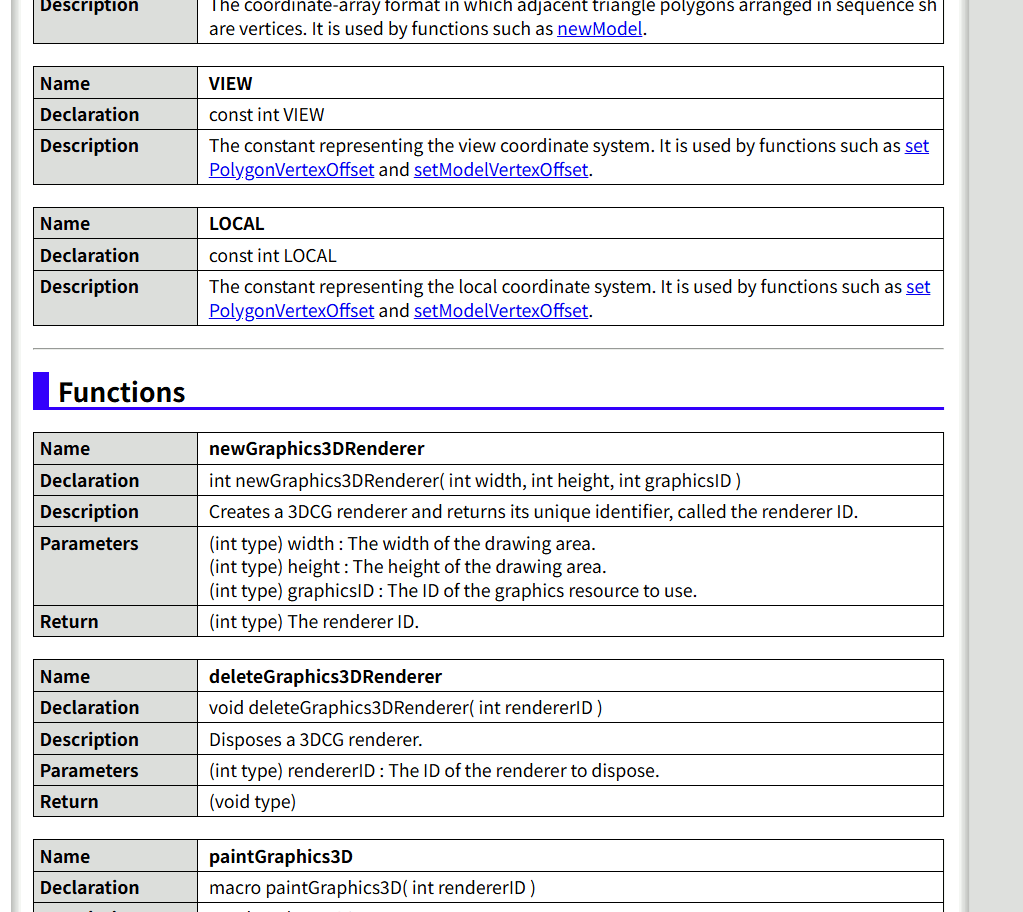
The translated library specifications are available at the following page:
Seeing even very large specifications such as the Graphics3D library fully available in English feels a little unreal, almost like a dream. Thanks to AI, we really are living in remarkable times.
For the final intensive phase of this translation work, we received help from the AI model "GPT-5.4" running in OpenAI's agent environment, "Codex."
In fact, this was the first time RINEARN had used an AI agent for translation work.
That is because translation is not something that can be done simply by mechanically converting Japanese into English. On the contrary, it requires careful attention to subtle nuance, so we had been quite cautious about applying AI agents to this kind of task.
Today, even when using AI for translation, there are multiple possible approaches, including chat-based workflows and agent-based ones. After trying the latter in practice this time, we found that each style has its own advantages and disadvantages. It seems important to choose the right approach depending on the situation.
In the next article, as a follow-up, we plan to share what we learned in more detail for readers interested in using AI for English translation. Stay tuned!
(Originally, we planned to include that discussion in this article, but it became too long, so we decided to split it into two parts.)